Palisades: 1920s and Yesterday
These are old photos of the Palisades, from the Cornell College archives. Mostly they are from the 1920s, although some are of earlier provenance, and some are a decade later. Of all the things that existed in those years, It seems like only the river has survived. All the activities, all the buildings, all the fun...where did it go?
…

I don’t recall ever seeing that sort of building anywhere near the water. Well, it’s been 90 years – I can’t imagine it would have been preserved. But where is this seemingly flat place along the river? What's accessible from the main entrance is very hilly indeed. And if I'm not mistaken, the water in the photo is closer to the riverbank than what I saw yesterday.
…

See that building at the top of the stairs? The stairs remain. The building is gone.
…
Yesterday, there was a sign posted just above the road: TREE FARM. I didn’t ask who farms, or why. Or how. Do they harvest trees for re-planting on lawns, or do they just chop them down for wood?
…

When I came to the park yesterday, I saw a riverbank extensively silted along the entirety of the Palisades, with very wide beaches. Springy red bushes grow there, and low tough grasses, but the bushes seem impermanent and the grasses seem like they won’t amount to much. So where is the beach in this picture? Come to think of it, I don't know where exactly this was taken...there are areas of the park up and downriver that are not attached to the main body.
…

But wherever the previous photo was taken, it had to be on the near shore, because the far shore is mostly limestone cliffs.
There's a building close to shore in the background, though it be hard to see.
Yesterday, The largest building close to shore was a public bathroom built of stone. Perhaps it’s the one in the photo? But the one in the photo is just a bit too large for that. Where have all the old shoreline buildings gone?
…

This photo is from when Cornell still held Pal Day (up until the 1970s). Everyone would skip class and go to the Palisades, teachers included – this was in response to the first year it occurred, which was done with no approval. Flunk day, they called it that first year, in 1920. There was, once, a commuter rail line between Cedar Rapids and Mount Vernon,


Of course, if you had the money to pay for a car (and it cost a lot back then), you could get there on your own.
…
The trees are curiously absent from the riverbank, as if they’ve only grown since then. Also curiously absent is a steep hill rising behind them, which may mean that this photo was taken in a different area than the main part of the park. There are some smaller sections up river and downriver.
…

This is the dam, newly-made. Is that a tree planted on it? Or is that where the dam meets the shore? Either way, it’s certainly not hydroelectric. In fact, I wonder why they built the thing in the first place. It may have been a make-work project, given that this is CCC handiwork. Maybe it was meant to control flooding, somehow? But no-one is sure what purpose it serves, or served.
Yesterday, I saw the dam, or what’s left of it. It’s mostly a pile of rocks and worn concrete, with whole trees on top. What hasn’t broken already is crumbling, and the corrugated sheets of metal stand mostly exposed. Rivers are not kind to manmade things. Rivers are not kind to that which refuses to yield.
…

The cliffs on the far shore slope down to meet the water, here and there.
Last November, my geology class went to the Palisades to observe the cliff on the far shore. we noticed a house atop the cliff, and the fact that the cliff is limestone, and we wondered how long it would take for the cliff to wear away and drop the house into the river. But limestone doesn't erode that fast. As a matter of fact, the average rate is something like 1/20 mm every hundred years. Still, it seemed funny to think about. It's usually a bad idea to build an expensive structure close to a river. This house and the house we saw are way up high, so they might be safe...but only because it's solid rock.
Perhaps a few years ago, the Hartford Courant had a front-page article about a man’s house on a raised bank of the Connecticut River. This was a spot where the water sped up and wore away at the shore, such that his house was doomed to fall into the river within a few years. It was a bank of dirt, though, not limestone.
…

Old inn. It was built in the 1890s. Does it still exist? The only structures given any mention in online descriptions of the park are the ones built by the CCC. But maybe it’s closer to the entrance, and I never noticed. How well is it maintained, if it does exist?
Yesterday, at a picnicking area above the stairs to the dam, I espied a water fountain. It’s missing a certain circular plate just above the handle, so when I turned the handle, the fountain spat out water at my hand and none of it reached the faucet. I expect that a building would have better maintenance. I hope.

Painting, early 20th century. Moonlight on Cedar River, where the water meets the cliff. It’s all purple and red and blue, instead of the blueish-silver that is actual moonlight. But it’s pretty enough. Note the absence of a beach. Why do I keep going on about that?
…

This one is, I believe, of an old mill. I never saw it. Does it still exist? I'm leaning more and more strongly towards no -- no, there's nothing here but the lodge, and the dam, and some small things. There's little trace of what was.
…

Canoes. There aren't any canoes at the Palisades now, only a concrete ramp for motorboats. The structure is a wooden dock. This photo is actually from 1980, for Alumni weekend.
…

Now we have a larger beach. Perhaps it is natural, then, and nothing to do with the dam. It is in the nature of a river to carry silt and sand and deposit it wherever, especially in a flood. The dam hasn’t done much besides catch a lot of rocks and trees, and someday it will all be swept away.
…

I found this spot yesterday, although the lawn is smaller now that there’s a paved road.
…

There is a beach, if you look closely, but it's not nearly as wide as what I saw. Where is this lovely spot along the Cedar River?
…

Now there's an idea.
…
Yesterday. A sign is posted at various points: WARNING. CEDAR RIVER HAS DANGEROUS CURRENTS.
…
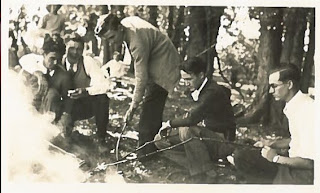
Probably Pal Day; they are doing a weenie roast. I prefer s’mores, if only because you can roast the marshmallows more quickly with a judicious application of burning.
…

The smoke makes me think that they’re doing a weenie roast – possibly the same one. But where is this? The place where it might have taken place is all overgrown with bushes beneath the trees now, but there are other spots…just not many along the river itself.
…

I have probably passed by these two buildings many times without giving them much thought. Or are they still there? The definite change is that the road in this photo is unpaved. Nearly all the roads in the Palisades are paved, now. It proved convenient yesterday. Not exactly quiet, especially when the motor-bikes are going by, but more convenient.
…

Pal Day again.
…
Yesterday. The area is full of underbrush now. Assuming, of course, that it’s the same area. But the park is only so large. Where else could they have been? There’s a walking trail at the north end of the paved road, but it’s all bumpy and rooty and twisty – they can’t have gone that way, right? So where did they go? Where did everything go?
Pal Day ended in 1971. I’m not sure why. Maybe the logistics of getting the entire campus to the park became too much. But Whatever the reason, it seems like there’s not as much going on at the park as the photos show. Granted, the photos showed an all-campus excursion. But the canoes, the tug-of-war, the picnic areas – none of it remains.
…
What the Palisades is now is something like this:

It's a bright bit of nature, and though it be a bit ragged, it is still beautiful. People don't come to the Palisades to see what was. They come to see what is.

What is is a place to walk in forest shade and sunlight
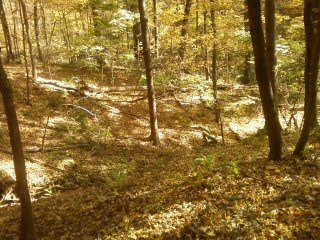
and down ravines

in a land of mostly farm fields. In that sense, though the buildings be gone,

the fun remains.
